Tag Archive for: Weminuche Wilderness

Trail access protected in Colorado’s Weminuche Wilderness

September 19, 2025-

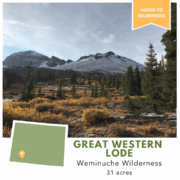
Earlier this summer the Trust transferred our 30-acre Needle Creek property, adding it to the Weminuche Wilderness. Last week we built off that momentum, transferring our 31-acre Great Western Lode properties to also be added to the Weminuche, once again growing Colorado’s largest wilderness area.

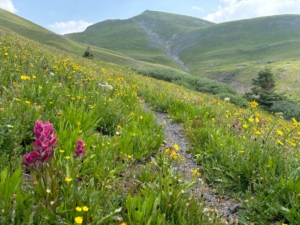
The Great Western Lode project is made up of three properties totaling 31 acres. Located about five miles north of the Needle Creek project, they protect fragile alpine tundra habitat. Like the Needle Creek project, the addition of Great Western Lode to the wilderness area secures public access on a popular trail. The 9.3-mile Whitehead Trail runs through two of the project’s three properties, and connects the Continental Divide Trail to the Highland Mary Trail and Deer Park Trails, which are easily accessible from the town of Silverton, Colorado, a year-round recreation destination.

All but 6 acres of Great Western Lode will be added to designated wilderness, enjoying the highest level of protection available to public lands that can only be altered by an act of Congress, not executive orders or other administration directives. The remaining 6 acres, which extends outside of the established wilderness boundary, will be added to San Juan National Forest to be managed as wilderness.

With the transfer of Great Western Lode, the Trust has protected a total of 15 properties covering over 265 acres in the Weminuche Wilderness.

Public access protected as the Weminuche Wilderness grows

June 25, 2025-

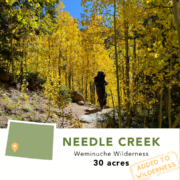
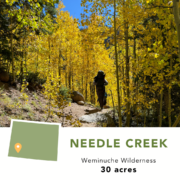
Earlier this year we shared the news that we had acquired a 30-acre private inholding in the Weminuche Wilderness of southern Colorado. Now we are thrilled to announce that the property has been transferred to public ownership to be protected as designated wilderness.

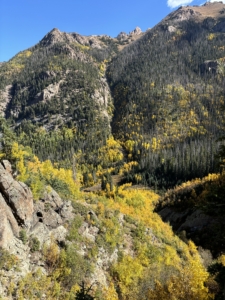
Running through the property are both Needle Creek and the Needle Creek Trail, which is used by hikers and climbers to access the very popular Chicago Basin and its surrounding 14,000+ peaks. With flat, buildable stream-side sites, the property was previously at risk of development. Now protected, public access on the trail to Chicago Basin has been ensured for future generations to enjoy. Needle Creek is an important tributary to the Animas River. This water source, along with vibrant aspen groves that stretch from the creek up the slopes of the Needle Mountains, create habitat for a wide range of wildlife. The Needle Creek property scores high for climate change resilience, biodiversity, and landscape connectivity, all important conservation values that will be protected as wilderness.

At just shy of half a million acres, the Weminuche Wilderness is the largest in Colorado. Spanning the continental divide, with an average elevation of over 10,000 feet, its rugged terrain provides important alpine habitat. Needle Creek is the 15th property protected by the Trust in the wilderness area, and builds off the success of the nearby 7-acre Emerald Lake property that the Trust acquired in 2018 and transferred to be added to the wilderness area in 2023.

While the property is now protected as wilderness, we will continue working with the USFS to complete some remaining restoration work this summer, removing the remnants of a hunting camp left by a previous owner. We are encouraged to see transfers of property like Needle Creek still moving forward under the new administration, and are grateful for our wonderful partners at the San Juan National Forest and Region 2 USFS office for working so diligently to move this project through the transfer process.

Public access to Colorado’s Chicago Basin protected!

January 24, 2025-

For most visitors, the hike to Chicago Basin in Colorado’s Weminuche Wilderness starts on the historic Durango & Silverton Narrow Gauge Railroad as it winds 30 miles through the mountains. From the train stop, the Needle Creek Trail climbs steadily for 6 miles till the valley opens up into the sweeping views of Chicago Basin and the surrounding peaks. Due to its convenient access from the train and to its iconic 14,000+ ft peaks, the basin is a popular destination, with heavy use through the summer months for hikers, backpackers, and mountaineers.

Most of those visitors who come to Chicago Basin for the scenic beauty and quiet solitude of the wilderness are unaware that the trail they’re traversing crosses several privately owned inholding properties where that experience is not guaranteed. Without the protections of the surrounding wilderness, these properties could be developed with cabins, resorts, or mining and timber operations. Suddenly their wilderness experience could be dominated by the buzz of chainsaws, the thwomp of landing helicopters, or even the trail blocked and closed to the public. This lingering threat to public access, as well as the integrity of the fragile, high alpine ecosystem has driven our work in the Weminuche, along with wilderness areas across the county.

The Trust recently protected our 15th property in the Weminuche Wilderness with the acquisition of a 30-acre private inholding property with both Needle Creek and the Needle Creek Trail running through it. With flat, buildable stream-side sites the property was at risk of development. Now protected, public access on the trail to Chicago Basin has been ensured for future generations to enjoy. Needle Creek is an important tributary to the Animas River. This water source, along with vibrant aspen groves that stretch from the creek up the slopes of the Needle Mountains, create habit for a wide range of wildlife. The Needle Creek property scores high for climate change resilience, biodiversity, and landscape connectivity, all important conservation values that will be protected as wilderness.

Now that the property has been acquired by the Trust, we will begin restoration work this summer to remove the remnants of a hunting camp left by a previous owner to restore it to its wilderness character prior to transfer to public ownership and addition to the wilderness. This project builds off the nearby 7-acre Emerald Lake property that the Trust acquired in 2018 and transferred to be added to the wilderness area in 2023.

A Tale of Two Emerald Lakes: Protecting Colorado’s Weminuche Wilderness

September 22, 2023-

The Trust recently completed the transfer of a 7.5-acre property on the slopes above Emerald Lake in the heart of Colorado’s Weminuche Wilderness. The project builds on two adjacent properties which the Trust already transferred into public ownership to be added to the wilderness area in 2020.

You may have heard of Emerald Lake as a popular backpacking destination in the Weminuche Wilderness. If you have, it’s almost certainly another Emerald Lake. Somewhat confusingly there are two named Emerald Lakes in the wilderness area (plus a Little Emerald Lake), and while both are accurately named for their emerald green waters, they are quite different. The Emerald Lake you may know is an hour’s drive and ten-mile hike from the small city of Durango. Sitting at 10,000 feet it is the third largest natural lake in Colorado and attracts backpackers ranging from solo hikers to families to groups of Boy and Girl Scouts. Local outfitters also guide horse packing trips to a site just above the lake. Generations of wilderness visitors have come to camp along Emerald Lake, some on their first backcountry tip, to see the vivid Milky Way reflected in its still waters, to listen to great horned owls calling through the treetops, and to watch the sun rise over the eastern ridge. 
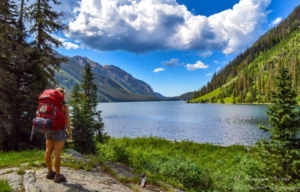
A backpacker at the popular Emerald Lake (Photo by Alex Gulsby from VisitDurango.org)

The Emerald Lake of the Trust’s recent transfer is some 13 miles west of the popular Emerald Lake and is 3% of the size. This Emerald Lake sits just above treeline at 11,300 feet and is surrounded by fragile alpine tundra. It’s about a mile and 1,500 ft climb through a dense drainage from the nearest trail and attracts very few and only the most intrepid of wilderness visitors. Alpine lakes like this serve as important biodiversity hotspots in the harsh high-elevation environment. The Trust’s work to protect even small properties in these areas conserves habitat for wildlife and rare plants like Heil’s Tansy Mustard.
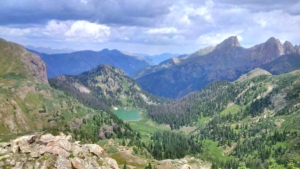
The ‘other’ Emerald Lake viewed from the Trust’s recently transferred property

While very different, both Emerald Lakes play important roles in our national wilderness landscape. We need wild places where families can go to unplug and explore together, just as we need wild places void of popular trails and campsites where wildlife can move unencumbered by human presence. Visitation to our National Forests increased by more than 20 million between 2016 and 2019 and skyrocketed by another 18 million from just 2019 to 2020. This trend was even more pronounced in wilderness areas where visitation almost doubled in 2020 after four years of minimal growth. These statistics represent many more people, and more diverse people, having the opportunity for life-changing wilderness experiences for the first time. And that’s something to celebrate in its own right. But it can also put a strain on natural resources and managing agencies. In 2021 USFS crews picked up 397 contractor-sized trash bags of garbage in the Columbine Ranger District, where the Weminuche Wilderness is located, showing the need for education to teach all visitors, whether it is their first visit or hundredth visit, how to recreate responsibly and leave no trace.

Growing visitation also shows how important it is to protect places like the ‘other’ Emerald Lake from threats of development. Our work to protect these places, largely unknown and unglamorous in the public eye, is critical in balancing the needs of wilderness landscapes and ensuring a refuge for nature and nature alone.