Mt. Shasta inholding protected

January 23, 2026-

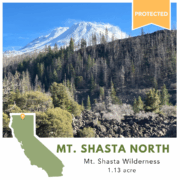
The Wilderness Land Trust recently acquired a 1 acre inholding within the Mount Shasta Wilderness of northern California. You may be wondering why bother protecting one acre within the almost 37,000 acre wilderness area? But every inholding, no matter their size, is a tear in the fabric of wilderness protection.

The Mt. Shasta North property is home to an ancient lava flow from the still active volcano, and has sweeping views of the summit to the southeast and broad valleys to the west. Located only 1/4 mile off a trail, it had been purchased by the previous landowner with the intention of building on it. Now that the property has been protected, there are only three inholdings left within the Mt. Shasta Wilderness, making this acquisition a meaningful step toward completing the wilderness area.

Once the property is transferred to public ownership and added to the designated wilderness, we’ll have mended the tear, removing the gap in habitat connectivity and making the fabric of wilderness as whole stronger than before.

960 acres protected in California’s Bodie Hills

October 3, 2025-

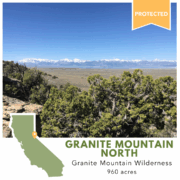
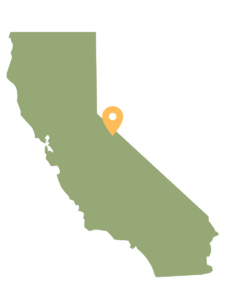
Where the high peaks of the eastern Sierra and Yosemite National Park meet the sagebrush steppe, the Bodie Hills of California remain one of the state’s most ecologically intact landscapes with some of its highest biodiversity. Here The Wilderness Land Trust recently acquired a 960-acre property adjoining the Granite Mountain Wilderness area, removing a significant threat of development from this important landscape.

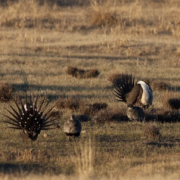
The Granite Mountain North property was purchased from private owners who had plans for residential development on it. With a road already built and well drilled on the property, the risk of development was well on its way. But over the course of seven years, the Trust worked with the landowners to find a different path forward for the property, completing the purchase of it last month. With the almost thousand-acre property now conserved, we have ensured its habitat for sage grouse and wild horses, as well as raptor nesting sites will be protected. Beyond the boundaries of the property itself, this acquisition helps maintain a buffer around the designated wilderness area, also benefiting its habitat, wildlife migration corridors, and scenic viewsheds.

Standing on the Granite Mountain North property with open views across the Bodie Hills and Mono Lake you can point to several other Wilderness Land Trust projects on horizon. With your support we have now protected around 8,000 acres in total in the area, stitching together a fragmented patchwork of public and private lands into a more unified and protected landscape.

Catching up with an old friend: Lundy Canyon

August 22, 2025-


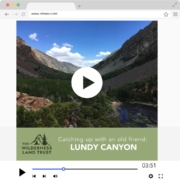
This summer, while working on projects in the nearby Bodie Hills, our staff had the opportunity to catch up with an old friend, our Lundy Canyon project, to see what successful protection of this once-vulnerable property looks like three years after it transferred to public ownership.

Today nothing separates the property from the surrounding Hoover wilderness. But that wasn’t always a given: a private buyer who wanted to put a permanent houseboat development on the small alpine lake was under contract to buy the property. That’s when The Wilderness Land Trust, with the help of our partners at the Mono Lake Committee and Eastern Sierra Land Trust, stepped in to purchase the property and eventually transfer it to public ownership.

Check out this short video to learn more about the project and see the lasting impact of your support.


California’s Mount Lassic Wilderness now complete with last remaining inholding removed!

January 10, 2025-

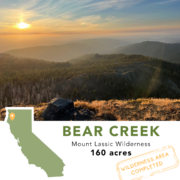
The Wilderness Land Trust recently acquired the last remaining inholding in northern California’s Mount Lassic Wilderness, completing the wilderness area by removing the lingering threat of development on the 160-acre Bear Creek private inholding property. This is the 18th wilderness area the Trust has completed.

The Mount Lassic Wilderness is of significant ecological importance, with several uncommon habitat features. Rare alpine vernal pools and unusual serpentine soils have created unique habitat conditions home to rare species. The endangered Lassics Lupine depends on the sufficient snowpack and shelter from summer heat found in the Mount Lassic Wilderness to survive. The area is also home to the northern spotted owl, blue grouse, marten, fisher, mountain lion, black bear, and goshawk. Old-growth forests of Douglas fir, incense cedar, and Jeffery pine cover much of the area.

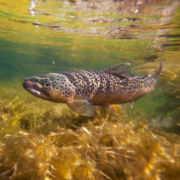
The 160-acre Bear Creek property includes tributary streams to the Wild and Scenic Van Duzen River. The Van Duzen River, as well as the Eel River which it flows into, host healthy salmon and steelhead runs. The salmon and steelhead populations are not only important species in the ecosystem, they support recreational and subsistence fisheries. The Van Duzen and Eel River host both summer and winter runs of steelhead, but as their waters warm due to climate change, the health of the fishery has become stressed. Juveniles require cold temperatures to survive, making cold water tributaries such as found in the Bear Creek property an important refuge.

With acquisition of the Bear Creek inholding property complete, we will now begin the process of transferring it to the Six Rivers National Forest. The Wilderness Land Trust has previously protected 253 properties totaling over 37,000 acres in 44 wilderness areas across California.

New protections for Washington and California’s wild places

February 23, 2024-

Lands added to Henry M. Jackson Wilderness & Lassen National Forest

This week we are celebrating successful transfers of properties in California and Washington to public ownership! Both projects protect habitat important for maintaining biodiversity and improve connectivity across the landscape.

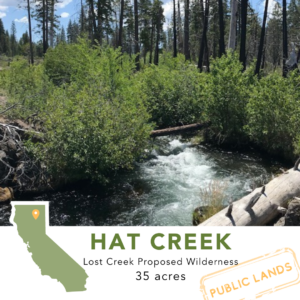
In northern California’s Lassen National Forest, 35 acres have been protected in an area proposed for future wilderness designation. The property provides an important connection between the proposed wilderness and Hat Creek, a trout fishery that Cal Trout and the Pit River Tribes have been working to restore. With good road access, the property was at high risk of development in the popular area for cabins and second homes just outside Lassen National Park. With the property’s addition to public lands, the road can be closed, adding to the roadless area eligible for wilderness designation.


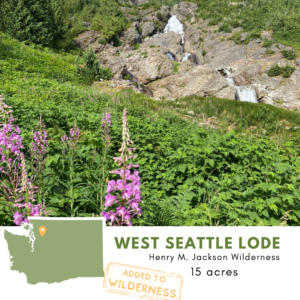
The 15-acre West Seattle Lode property has been added to Washington’s Henry M. Jackson Wilderness. The property was our first acquisition in the wilderness area in 2022, which adjoins the Wild Sky Wilderness. This rugged, glaciated landscape is home to the endangered Northern Spotted Owl, Cascade red fox, pika, wolverines, and Marbled Murrelet, a seabird that nests in old-growth forests and alpine slopes. The property is on a steep slope that overlooks the Monte Cristo ghost town, the site of a gold and silver mining boom lasting from 1895-1912, and a popular hiking destination.

The Hat Creek and West Seattle Lode projects are great examples of how protecting small properties can have positive impacts that reach well beyond their boundaries.


Get more wilderness news delivered to your inbox!


By submitting this form, you are consenting to receive marketing emails from: Wilderness Land Trust. You can revoke your consent to receive emails at any time by using the SafeUnsubscribe® link, found at the bottom of every email. Emails are serviced by Constant Contact

Mendocino National Forest grows by 917 acres

December 12, 2023-

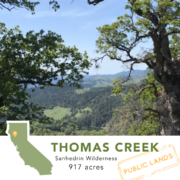
The Wilderness Land Trust recently transferred 917 acres adjacent to California’s Sanhedrin Wilderness to public ownership.

In northern California’s Mendocino County, tucked between the Wild and Scenic Eel River and peaks of the Sanhedrin Wilderness, 917 acres of formerly private land have been transferred to public ownership. The property, known as the Thomas Creek project, provides a link between lower-elevation habitats and the mature fir forests that blanket the high country, as well as a critical wildlife corridor between the Sanhedrin Wilderness to the north and other National Forest lands to the south.

Its rolling hills are spotted with protected oak savannah and groves of madrone trees, home to a thriving community of rare plants, spotted owls, martens, bears, mountain lions, and deer.  Among the rare plant species is the Anthony Peak lupine which only grows in Mendocino National Forest. The property also contains one of the last private sections of Thomas Creek, an important tributary to the Eel River, and critical spawning grounds for its steelhead and coho salmon fisheries.

The Thomas Creek project scored as a high conservation priority for the Trust and National Forest for its climate change resilience value and high threat of development with the potential to be subdivided into six building sites.

“The Thomas Creek project meets the mark for all the benefits of designating public lands – it’s going to protect critical habitat and treasured species, support biodiversity, and get us closer to our conservation and climate goals. I’m incredibly grateful to the Wilderness Land Trust and the Mendocino National Forest for stepping up as stewards of this land.”   – Congressman Jared Huffman

Due to its importance in regional conservation efforts, the project has also gained support from the Backcountry Hunters and Anglers California Chapter, CalWild, Friends of the Eel River, Redwood Chapter of the Sierra Club, and Willits Environmental Center.

The Wilderness Land Trust purchased the property in October 2022. The Trust had previously purchased another property from the private owner in 2011. With this established relationship, the landowner trusted the Wilderness Land Trust and Mendocino National Forest would ensure its protection for future generations. For the last year, the Trust has been working with Forest Service leadership at Mendocino National Forest, the regional office, and Washington D.C. to complete the transfer of this important landscape to public hands. The transfer to public ownership was made possible by Land and Water Conservation (LWCF) funds with support from Rep. Huffman and the late Sen. Feinstein.

Get more wilderness news in your inbox!

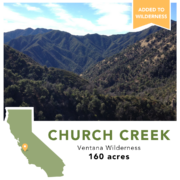
160 Acres Protected in the Ventana Wilderness of California

August 25, 2023

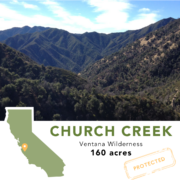
This week The Wilderness Land Trust completed the purchase of 160 acres in the Ventana Wilderness of California. 

In the heart of California’s Central Coast, the 160-acre Church Creek property overlooks the wild sharp-crested ridges and steep valleys of the interior coastal range. The property connects to over 2,000,000 acres of public lands that provide critical wildlife habitat in the middle of a biodiversity hotspot. With several streams, the Church Creek property maintains important habitat resources for resident and migrating species in this dry landscape. The property also provides public access with a trailhead connecting two popular trails.

The property was owned by the San Francisco Zen Center in connection to its nearby Tassajara Mountain Zen Center. Together the San Francisco Zen Center and The Wilderness Land Trust have ensured the threat of development is removed, and the property will become public lands for all to enjoy.

“There’s an old Zen saying: ‘If I take care of the mountains, they will take care of us.’ We share this quality of intimate connection with nature with the Wilderness Land Trust, and we deeply appreciate the protection and care this land will continue receiving in the future.”

– Sozan Miglioli, President of San Francisco Zen Center

With incredible vistas, flat building sites, and access via a public road, the Church Creek property would have been at high risk of development had it sold to a private buyer. The next step for this property is to be transferred to Los Padres National Forest. With over 2,000 acres of private inholdings remaining in the Ventana Wilderness, there is still more work to be done. But for now, thanks to the San Francisco Zen Center’s vision and the support of our donors and partners, there are 160 fewer acres at risk.

Unifying the Bodie Hills Landscape

January 27, 2023- 

This week The Wilderness Land Trust completed the transfer of 1,698 acres of sagebrush steppe in the eastern Sierra to public ownership.

Located in the Bodie Hills, just east of Yosemite National Park, the property stretches across five parcels, dispersed throughout a large ranch holding.

The Bodie Hills have some of the highest ecological intactness and species richness in the region, and are ranked in the top 10% of unprotected BLM lands in California for biodiversity. Despite the ecological importance of the region, it is a patchwork of private property and public lands managed by the Forest Service and Bureau of Land Management with three Wilderness Study Areas covering much of it. Wilderness designation efforts, such as those in the Bodie Hills, are often hindered by the presence of private land fragmenting the landscape as it creates an inability to control critical habitat components to assure the viability of a designation.

Since we began our work in the Bodie Hills in 2006, the Trust has purchased five large properties there totaling just over 7,000 acres. This is the third of them to be successfully transferred to public ownership. Thanks to the support of and partnerships with local conservations groups and tribes, we are steadily unifying ownership in the area, removing piecemeal management and fragmented habitats. It won’t be solved overnight, but the cumulative impact of almost twenty years of work and your support is moving us closer to the goal of protecting this important landscape.


Connecting habitat in California’s Central Coast

November 17, 2022-

This week The Wilderness Land Trust transferred the Trout Creek 4 property to public ownership, expanding the protected connection between the Santa Lucia and Garcia Wilderness areas.

Just inland from the rugged cliffs and secluded beaches of the central California coast, the Santa Lucia and Garcia Wilderness areas are tucked in the rolling hills of chaparral and towering oaks. Less than an hour from San Luis Obispo, the two wilderness areas total over 34,000 acres and are separated by just a few miles, and Trout Creek.

Over the past few years The Trust successfully purchased and transferred three properties to public ownership in the Trout Creek drainage. This week we expanded that success with the transfer of a fourth 148-acre property.

In this dry landscape, streams like Trout Creek are important water sources for resident and migrating species. The area, which is part of a biodiversity hotspot, provides critical habitat for wildlife ranging from the endangered California condor to the threatened California red-legged frog. Protecting these landscapes, and their wild inhabitants, increases the region’s resilience to a changing climate.

The Central Coast Heritage Protection Act, which is currently making its way through the houses of Congress, includes the proposed designation of additional wilderness connecting the Santa Lucia and Garcia wilderness areas. The Trust’s work in the Trout Creek drainage

has removed the last islands of private property, clearing the way for connectivity across the landscape for wildlife corridors and recreational access.

Thanks to your support and our partners at Los Padres National Forest and USFS Region 5, these lands are now secured for future generations to enjoy!

900 Acres of Critical California Habitat Protected

October 7, 2022- In northern California’s Mendocino County, tucked between the Wild and Scenic Eel River and peaks of the Sanhedrin Wilderness, lies 900 acres of private land known as the Thomas Creek property.  Last week The Wilderness Land Trust closed on the property and is now in the process of transferring it to Mendocino National Forest. 

The rolling hills of the Thomas Creek property are spotted with protected oak savannah and groves of madrone trees, home to a thriving community of rare plants, spotted owls, martens, bears, mountain lions, and deer.  Among the rare plant species is the Anthony Peak Lupine which only grows in Mendocino National Forest. The Thomas Creek property provides a link between lower-elevation habitats and the mature fir forests that blanket the high country, as well as a critical wildlife corridor between the Sanhedrin Wilderness to the north and additional National Forest lands to the south.

The property also contains one of the last private sections of Thomas Creek, an important tributary to the Eel River, and critical spawning grounds for its steelhead and coho salmon fisheries.  The Eel River hosts both summer and winter runs of steelhead, but as its waters warm due to climate change, the health of the fishery has become stressed. Juveniles require cold temperatures to survive, making cold water tributaries such as Thomas Creek an important refuge.

Due to its importance in regional conservation efforts, the project has gained support from the Backcountry Hunters and Anglers California Chapter, Redwood Chapter of the Sierra Club, and Willits Environmental Center.

“The Thomas Creek project will contribute substantially to meeting the larger regional conservation efforts”.    -Ellen Drell, Willits Environmental Center Director

“This purchase would also be an excellent addition and model for State and Federal 30×30 goals to conserve and restore 30% of lands and waters by 2030.”     -Devin O’Dea, California Chapter Coordinator Backcountry Hunters & Anglers

Our relationship with the private landowner began in 2011 when we purchased another of their nearby properties located inside the wilderness boundaries to help complete the newly designated Sanhedrin Wilderness. So, when it came time for the landowner to decide the future of this property, they had confidence that the Wilderness Land Trust and Mendocino National Forest would ensure its protection for future generations and complete the deal efficiently and professionally. The 900-acre property became a high priority for the Trust and the agency for its climate change resilience value and high threat of development with the potential to be subdivided into six building sites.

Over the coming months, we will be working closely with the USFS leadership at Mendocino National Forest, the regional office, and Washington D.C. to complete the transfer of this important landscape to public hands.