Tag Archive for: Frank Church River of No Return Wilderness

Annie Creek added to Idaho’s Frank Church River of No Return Wilderness

October 17, 2025-

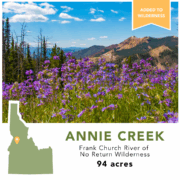
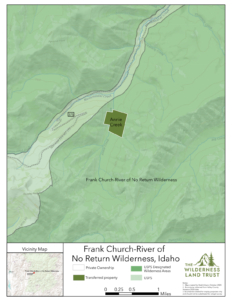
The Payette Land Trust and Wilderness Land Trust partnered to purchase a 94-acre private inholding within Idaho’s Frank Church River of No Return Wilderness in August 2024, safeguarding Annie Creek from development. This property was recently transferred into public ownership, adding it to the designated wilderness area.

The Annie Creek property is located near the western edge of the wilderness area, approximately 40 miles from McCall, Idaho. Surrounded by the steep, forested terrain characteristic of the Frank Church, the property includes gentler slopes, creeks, wetlands, and flat building sites, which were used in the early 1900s during Idaho’s mining boom. Located near a well-maintained road, the property was particularly vulnerable to development. Private inholdings within designated wilderness areas carry none of the protections of the surrounding wilderness and can be developed with cabins, resorts, or even industrial sites. The threat of development was removed when the two land trusts, with generous support from the Leuthold Foundation, purchased the inholding from a private owner. Now in public hands, Annie Creek will enjoy the highest level of protection available to public lands as designated wilderness, which can only be altered by an act of Congress, not through executive order or administration directive.

At 2.3 million acres, the Frank Church River of No Return Wilderness is the largest wilderness area in the lower 48 states and is home to over 180 miles of the free-flowing Salmon River. Its large, connected habitats are rich in biodiversity with over 280 species of mammals, fish, birds, reptiles, and amphibians. The addition of the Annie Creek property to the wilderness area will help protect important wildlife habitat and strengthen connectivity across the landscape.

“Idaho is changing at a rapid rate which requires voluntary partnerships between private landowners, organizations and foundations to conserve Idaho’s natural beauty. We are proud to work with The Wilderness Land Trust and the Leuthold Foundation to conserve this unique landscape into the future”

-Payette Land Trust Executive Director, Craig Utter

“Thanks to our partnerships with the Payette Land Trust and the Leuthold Foundation, this special place will be protected for future generations to enjoy in one of America’s most iconic wilderness areas”

-The Wilderness Land Trust President, Brad Borst
In the organization’s 33-year history, The Wilderness Land Trust has worked to keep the promise of wilderness by acquiring these private inholdings from willing landowners and transferring them to federal ownership to become designated wilderness. In this time, the Trust has purchased and transferred 614 properties totaling over 59,000 acres from Arizona to Alaska, completing 18 wilderness areas by removing their last remaining private inholdings. With each transfer, we come one step closer to completing the vision of the Wilderness Act. Learn more at www.wildernesslandtrust.org.

Payette Land Trust (PLT) works to conserve the wild and working lands of West Central Idaho by partnering with private landowners, communities, and conservation organizations to balance conservation and development. PLT currently owns or holds conservation easements on 21 properties totaling 3,891 acres across Adams, Idaho, Valley, and Washington counties. Through projects like the Annie Creek partnership, PLT advances its mission of voluntary, community-based conservation for the benefit of current and future generations. Learn more at www.payettelandtrust.org.

Protecting bat habitat in the Frank Church River of No Return Wilderness

September 5, 2025-

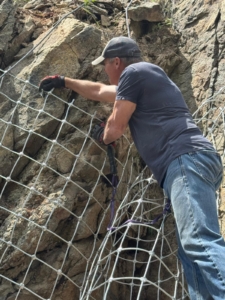
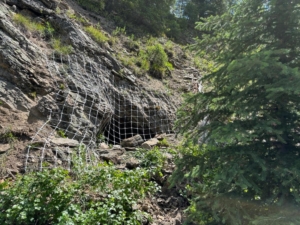
Given that many of the private wilderness inholdings that we work to protect are old mining claims, it’s not uncommon to find open mine shafts or adits, the horizontal passages used to access underground mines, on them. When we do, it is important to close them off before the property becomes public lands to ensure public safety. Our staff recently visited our Annie Creek project in Idaho’s Frank Church River of No Return Wilderness, which we acquired in last year in partnership with the Payette Land Trust, to close two open adits on the property. But how that’s done has a big impact on one of wilderness’s little thought of, but most important species: bats.

There are at least 13 species of bats in the Frank Church River of No Return Wilderness. A single little brown bat, one of the most common species found there, can consume over 1,200 mosquito-sized insects in just one hour. If you’ve ever tried to put up a tent or cook your dinner while camping in the thick of mosquito season, that alone may be enough to convince you of the importance of bats in the wilderness. But bats are also critical for healthy forests, protecting young trees from insect damage. Researchers have found that forest where bats are present have three times less insects and five times less defoliation of young trees than forests without bats. When young saplings are defoliated, having their leaves eaten by insects, they are more vulnerable to stressors like drought and fungal diseases. Beyond playing an important pest control role in forests, bats eat enough pests so save more than $3 billion a year in crop damage and pesticide costs across US agricultural production. Bats are also important pollinators. But due to disease and habitat loss, bat populations are in decline across the country.

While many species of bats actually roost in trees, habitat like caves and abandoned mines are important for reproduction and raising their young. So when it comes to closing off mine adits on the Trust’s properties, we make sure that they are still accessible to bats. Sometimes, when the property is easily accessible, that means installing steel bars or grates across the opening. In Colorado, the Division of Reclamation, Mining, & Safety has a program to help install these grates, but no such program exists in Idaho. In the case of Annie Creek, where steel grates would be too heavy to hike in, we had custom cable nets fabricated to stretch across the roughly 5×7’ opening and bolt into the rocks surrounding them. Quarter inch cables are used to create a six-inch square mesh, ensuring bats can easily fly through them.

Our staff were joined by two of our local USFS partners, and we were able to hike in all the materials and install both nets in just one day, instead of the two we had anticipated it would take. This kind of stewardship and restoration is an important part of our work, both to ensure that properties are cared for after we acquire them, and to return them to their wilderness character and mitigate any safety hazards before they become wilderness and public lands.


Idaho Capital Sun- Former mining claim added to Idaho’s Frank Church River of No Return Wilderness

The Idaho Capital Sun celebrates the recent addition of the Surprise Lode property to Idaho’s Frank Church River of No Return Wilderness.

August 26, 2023


Expanding Idaho’s wilderness with lessons from the life of Polly Bemis

August 11, 2023

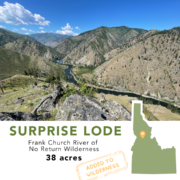
This week The Wilderness Land Trust completed the transfer of the 38-acre Surprise Lode property, adding it to Idaho’s Frank Church River of No Return Wilderness. This project builds off the adjacent Painter Mine property we transferred in 2017.

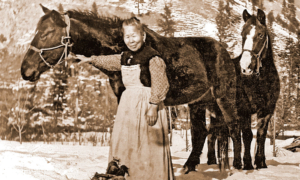
Earlier this summer we visited the Surprise Lode property with our USFS partners in preparation for its transfer and addition to the wilderness. At the end of the visit, as we were headed back downriver, our jet boat captain handed me a photo book sealed in a ziplock bag. Inside were historic photos, many showing the inhabitants of the old homesteads and mines we’d passed along the river. The captain pointed to a photo of a Chinese woman beside a horse and said “That’s Polly, you’d like her. She was a neat lady and lived an amazing life out here”. Later, once I’d returned home to Montana, I found her story, along with the story of many others who made this incredible wilderness landscape their home.

The Salmon River Canyon has been inhabited for almost 10,000 years, first by the Old Cordilleran people in the late Pleistocene, then by their descendants the Nez Perce and Mountain Shoshone tribes. The river and surrounding wilderness remain an important cultural and spiritual homeland for the tribes. The first white men to travel the Salmon River were trappers and hunters in the 1830s, followed by gold miners in the 1860s. Travel by land through the Salmon River Canyon, which is deeper than the Grand Canyon, was very difficult. So miners would build and launch wooden scows upriver in the town of Salmon, then once they’d reached their downstream destination, disassemble their boats to build cabins. This gave this river its nickname as the “river of no return”.

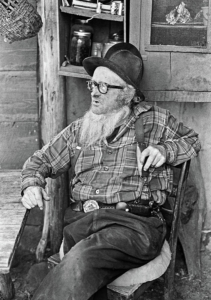
Buckskin Bill

As the gold rush boomed then busted, the Salmon River was home to some iconic characters. Some were expected like Buckskin Bill, known as the ‘last of the mountain men’ who made his home just downriver from the Surprise Lode property in the 1930s and built a stone gun tower, which still stands, above his cabin to “defend it” from the USFS seeking to protect the area.

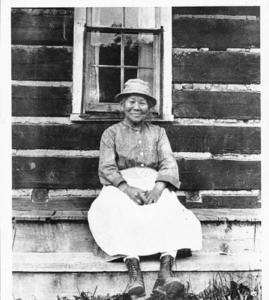
Others, like Polly Bemis, were less expected. Standing at only 4’5”, Polly was born in northern China in 1853, where she was sold into slavery and brought to San Francisco, then Warren, Idaho where, at the age of 19, she was sold to a saloon owner. It’s unclear how Polly gained her freedom, but by the 1880 census she was listed as living with her friend Charlie Bemis, who had looked out for her since her arrival in Warren. Once free, Polly was financially independent, taking in laundry and building and running her own boarding house. Charlie and Polly later married, and in 1894 they moved to a remote homestead on the Salmon River where they staked a mining claim.

For much of her life, Polly’s story was written by others— she was enslaved, taken from her home, and almost certainly endured the intense discrimination that Chinese Americans faced on the frontier. Even decades after her freedom, a rumor that she had been won in a poker game still persisted, despite her insistence it wasn’t true. But on the banks of the Salmon, she was able to write her own story. Along with Charlie, she made her home, keeping a garden and caring for a number of animals including horses and a cougar. She was known and admired by homesteaders and miners throughout the area for her nursing skills, as an expert angler, and for her toughness, friendliness, wit, and sense of humor. She was known for who she was- for her kindness, skills, and talents- not as property or a trite stereotype.

In 1922 their cabin burnt down and a few months later Charlie died, likely of tuberculosis. After rebuilding her cabin with the help of her neighbors, Polly went on living by herself in the rugged wilderness until her death in 1933 at the age of 80. Since then Polly has become something of an icon, with a book Thousand Pieces of Gold based on her life, her restored cabin on the National Register of Historic Places, and her induction into the Idaho Hall of Fame.

Polly’s story struck me, both as a welcome diversion from the typical mountain man archetype, as well as a portrait of the freedom and sense of self that she, and many after her, found in the wilderness. For so many of us, our relationship with wilderness is shaped by the freedom we feel in it, the community that it connects us to, and the self-discovery that comes from solitude and hard days on its trails. Polly’s story reminds us that wilderness is for everyone, not just those you’d expect to find in it. And it reminds us how important it is to protect wilderness so that future generations have the opportunity to find their way in the world through it, just as she did.

A few miles upriver from where Polly is buried, we’re proud to be adding 38 acres to the wilderness she loved.

– Margosia Jadkowski, Director of Marketing & Communications

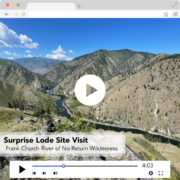
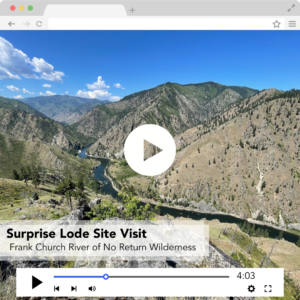
Come along on a virtual site visit in the Frank Church River of No Return Wilderness

June 30, 2023- Field season is in full swing for our Lands Staff as they visit our project sites in wilderness areas across the west. As we work to acquire or transfer properties our staff conduct several site visits to assess property values, the wilderness character of the property, whether any restoration work is necessary, and to coordinate with landowners and agency partners.

Join us on a virtual site visit to the Surprise Lode property in the Frank Church River of No Return Wilderness with this 4-minute video and learn more about the project!