Wilderness Land Trust
  • ABOUT
    • Our Mission
    • Our Story
    • Our Staff
    • Our Board
    • Join Our Team
    • Newsletters
    • Annual Reports & Financials
  • HOW WE WORK
    • Our Process
    • Stories
    • Landowners
    • Videos
    • Wilderness Book Club
  • NEWS
    • Recent News
    • Press
  • PROJECTS
    • Projects by State
  • GET INVOLVED
    • Donate
    • Ways to Give
    • Support a Project
  • CONTACT US
  • Donate Now
  • Click to open the search input field Click to open the search input field Search
  • Menu Menu

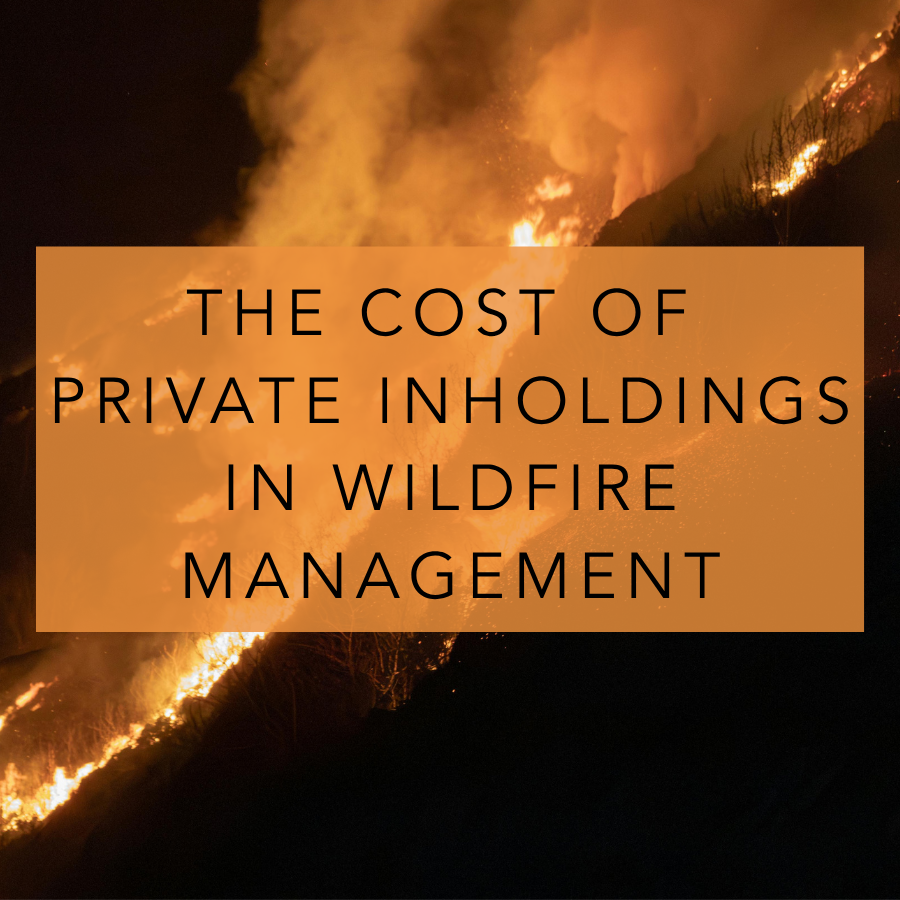
The Cost of Private Inholdings in Wildfire Management

June 26, 2026-

Right now, somewhere in the West, a wildfire is burning and fire managers are studying maps, calculating risk, and making decisions that will shape a landscape for the next century. When that fire burns near one of the 3,000 private properties that sit in the middle of designated wilderness, how those decisions are made can change drastically.

When a fire starts naturally in wilderness, and only forest or grasslands lie in its path, fire managers can choose to let it burn under safe conditions, allowing it to reduce fuels, create habitat, and restore the ecological processes the Wilderness Act was designed to protect. But when a private inholding enters the equation, particularly when it contains a cabin, resort, or mining operation, the ‘values at risk’ calculation that drives fire management decisions shifts. And rather than managing the fire to promote ecological integrity, private property protection often becomes the priority.

We know that there is a hard cost associated with defending private inholdings: wildland firefighting costs increase as much as 50x when structures are threatened. But there is also a second cost— the missed opportunity cost of not allowing fires to burn naturally. For much of the 20th century, public land management operated on the premise that fire was bad, and putting it out was good. We now know that isn’t always true, especially in wilderness. Fire is not a disaster that happens to forests. It is a process that forests evolved with, depend on, and in many cases require to stay healthy. Fire is what ecologists call a “keystone process”, one that structures entire ecosystems. When fire moves through a landscape, it doesn’t destroy uniformly. It burns hot in some places and cool in others, kills some trees and spares others, opens the canopy here and leaves it intact there. The result is called pyrodiversity: a patchwork of habitats at different stages of recovery, supporting a far wider range of plants and animals than any single-aged, fire-suppressed forest can. Research increasingly shows that this diversity of fire history directly promotes biodiversity, including among pollinators and flowering plants. This isn’t new knowledge; indigenous communities across the West understood and practiced it for thousands of years, deliberately burning to manage landscapes, protect communities, and support the plants and animals they depended on.

There are many instances where fires in the wildland-urban interface cannot safely be left to burn, when communities, homes, and lives are at risk. And as many of our finite firefighting resources as possible should be directed to those areas where so much is at stake. But deep in wilderness, many miles from the nearest road, there is great value in letting them burn. One of the many benefits of the Trust’s work to remove private inholdings from within wilderness is simplifying the calculations that fire managers must make to allow the natural fire cycles, which ecosystems evolved to rely on, govern themselves. In some wilderness areas we’ve removed as many as 36 private inholding properties, and we have successfully removed every last inholding from 18 wilderness areas from New Mexico to Washington. In each of these instances, we’ve made it an incrementally easier decision to truly allow these wild places to be wild, to follow the natural cycles they have for millennia, untrammeled by human interference.

Share this entry
  • Share on Facebook
  • Share on X
  • Share by Mail
https://wildernesslandtrust.org/wp-content/uploads/2026/06/Copy-of-Copy-of-annual-report-banner-3-x-3-in.png 900 900 Margosia Jadkowski https://wildernesslandtrust.org/wp-content/uploads/2024/12/wilderness-land-trust-logo-2024.png Margosia Jadkowski2026-06-26 10:21:252026-06-26 10:22:03The Cost of Private Inholdings in Wildfire Management

Join Us

Get more wilderness news delivered to your inbox!

Select list(s) to subscribe to


By submitting this form, you are consenting to receive marketing emails from: The Wilderness Land Trust, PO Box 881, Helena, MT, 59624, https://www.wildernesslandtrust.org. You can revoke your consent to receive emails at any time by using the SafeUnsubscribe® link, found at the bottom of every email. Emails are serviced by Constant Contact

Recent News

  • What we can learn from the Roadless Rule public comments
  • Catching up with an old friend: Old Woman Mountains Wilderness
  • Protecting a haven for endangered wildlife in Southern California
  • One step closer to wilderness for Snowmass Falls Ranch
  • What the Roadless Rule means for wilderness
7,373 acres protected across Colorado and counting 7,373 acres protected across Colorado and counting! Give where you live, and help us continue to protect the wilderness you love this Colorado Gives Day. Early giving is now open through the link in our bio!
Over 1 million people participated in the public c Over 1 million people participated in the public comment period for the proposed rescission of the Roadless Area Conservation Rule, with 390,000 submissions and 81,000 unique comments.
 
We can learn a lot from them. We know that 97% of them opposed rescinding the Roadless Rule, and that the top topics mentioned in them were environmental protection and biodiversity; recreation, tourism, and public use; water quality and quantity; wildlife habitat; and forest management and wildfire.
 
But what was most striking when reading through comments was what the arguments were built on. They speak about experiences in these places, shared across generations, and the impact they have had on people from all walks of life. They reflect heritage and traditions passed down through families and cultures. They hold a remarkable amount of hope and continued trust in a shared vision for the future of our planet. They value the common good over the profit of the few. They speak up for all life, not just human life. They trust in science. They revere beauty and something greater than ourselves. 
 
We can also learn a great deal from comments in favor of opening up roadless areas. While some represent industry interests, many come from people with a deep connection to these lands. Some share the experiences of people with disabilities who are limited in how they can access public lands. Some point to communities, many of them Native, who rely on these lands for subsistence uses and rural economies. Others reflect the fears of communities increasingly impacted by wildfires. All of these voices should be welcomed and represented in decision-making for our public lands.
 
While it’s yet to be seen how these comments will be reflected in the fate of the Roadless Rule, they’ve provided an important opportunity for us to take a moment to listen to our neighbors and better understand our community.
We need your help to protect Robinson Creek! In We need your help to protect Robinson Creek!
 
In California’s Eastern Sierra, the Hoover Wilderness is a spectacular and rugged landscape of alpine lakes, blooming meadows, and granite spires and domes. The Robinson Creek property sits in its heart, overlooking to popular Robinson Creek Tail which leads hunters, anglers, and sportsmen in to the wilderness and neighboring Yosemite National Park. 
 
Your generous contribution will help us raise the remaining $21,750 needed to complete the project and protect the Robinson Creek property as wilderness. 

Donate today through the link in our bio.
With the Agua Blanca property now safeguarded from With the Agua Blanca property now safeguarded from development, we’re helping to protect watersheds and connected habitat for wildlife, and ensure future generations have the opportunity to experience wilderness solitude and inspiration.
A black bear joined Trust supporters in the Roarin A black bear joined Trust supporters in the Roaring Fork Valley of Colorado yesterday to hear about our work protecting local wilderness areas.
For Connie Myers protecting wilderness is all abou For Connie Myers protecting wilderness is all about having wild places to connect with who we are as human beings.
Follow on Instagram

Find us on Facebook!

X Logo X Logo Followon X
  • About
  • How We Work
  • News
  • Get Involved

THE WILDERNESS LAND TRUST
PO BOX 881
HELENA, MT 59624

PHONE: 206.397.5240

EIN 84-1192823

Stay Connected

Select list(s) to subscribe to


By submitting this form, you are consenting to receive marketing emails from: The Wilderness Land Trust, PO Box 881, Helena, MT, 59624, https://www.wildernesslandtrust.org. You can revoke your consent to receive emails at any time by using the SafeUnsubscribe® link, found at the bottom of every email. Emails are serviced by Constant Contact
© Copyright Wilderness Land Trust 2018
  • Terms of Use
  • Privacy Policy
Link to: Building impact across a landscape in the San Juan Mountains Link to: Building impact across a landscape in the San Juan Mountains Building impact across a landscape in the San Juan Mountains Link to: For the Love of Wilderness: Share your stories, roll up your sleeves, and give with impact Link to: For the Love of Wilderness: Share your stories, roll up your sleeves, and give with impact For the Love of Wilderness: Share your stories, roll up your sleeves, and give...
Scroll to top Scroll to top Scroll to top
Give Now

Donate