The Cost of Private Inholdings in Wildfire Management
June 26, 2026-
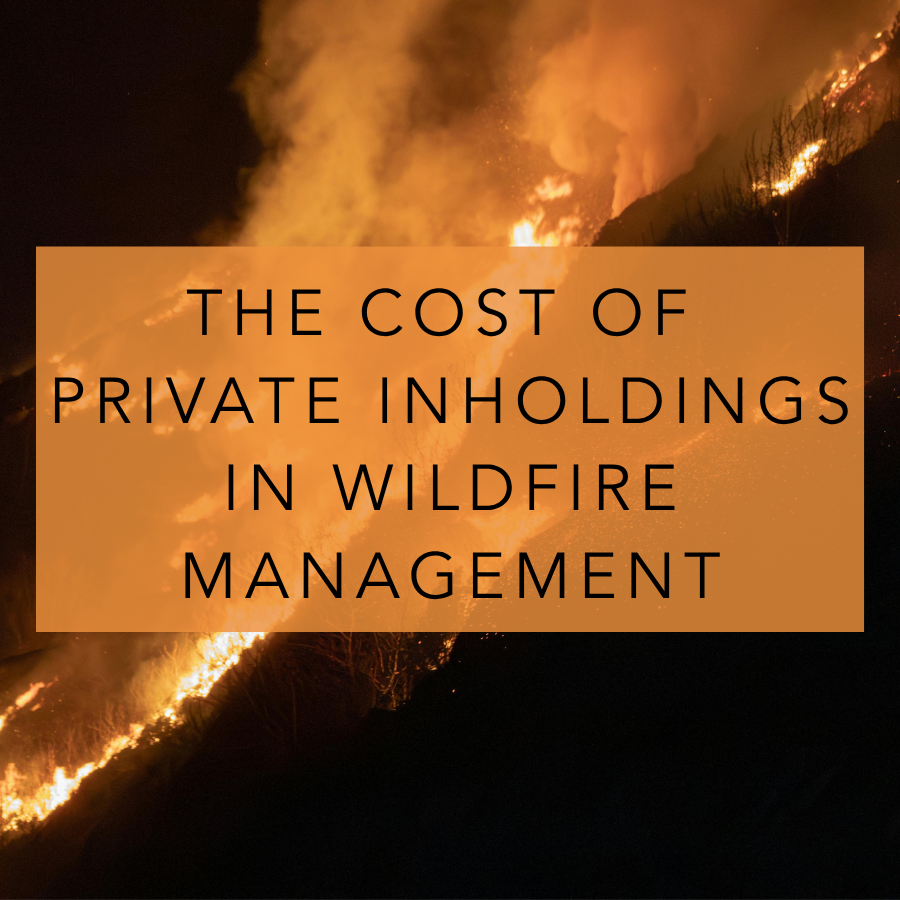
Right now, somewhere in the West, a wildfire is burning and fire managers are studying maps, calculating risk, and making decisions that will shape a landscape for the next century. When that fire burns near one of the 3,000 private properties that sit in the middle of designated wilderness, how those decisions are made can change drastically.
When a fire starts naturally in wilderness, and only forest or grasslands lie in its path, fire managers can choose to let it burn under safe conditions, allowing it to reduce fuels, create habitat, and restore the ecological processes the Wilderness Act was designed to protect. But when a private inholding enters the equation, particularly when it contains a cabin, resort, or mining operation, the ‘values at risk’ calculation that drives fire management decisions shifts. And rather than managing the fire to promote ecological integrity, private property protection often becomes the priority.
We know that there is a hard cost associated with defending private inholdings: wildland firefighting costs increase as much as 50x when structures are threatened. But there is also a second cost— the missed opportunity cost of not allowing fires to burn naturally. For much of the 20th century, public land management operated on the premise that fire was bad, and putting it out was good. We now know that isn’t always true, especially in wilderness. Fire is not a disaster that happens to forests. It is a process that forests evolved with, depend on, and in many cases require to stay healthy. Fire is what ecologists call a “keystone process”, one that structures entire ecosystems. When fire moves through a landscape, it doesn’t destroy uniformly. It burns hot in some places and cool in others, kills some trees and spares others, opens the canopy here and leaves it intact there. The result is called pyrodiversity: a patchwork of habitats at different stages of recovery, supporting a far wider range of plants and animals than any single-aged, fire-suppressed forest can. Research increasingly shows that this diversity of fire history directly promotes biodiversity, including among pollinators and flowering plants. This isn’t new knowledge; indigenous communities across the West understood and practiced it for thousands of years, deliberately burning to manage landscapes, protect communities, and support the plants and animals they depended on.
There are many instances where fires in the wildland-urban interface cannot safely be left to burn, when communities, homes, and lives are at risk. And as many of our finite firefighting resources as possible should be directed to those areas where so much is at stake. But deep in wilderness, many miles from the nearest road, there is great value in letting them burn. One of the many benefits of the Trust’s work to remove private inholdings from within wilderness is simplifying the calculations that fire managers must make to allow the natural fire cycles, which ecosystems evolved to rely on, govern themselves. In some wilderness areas we’ve removed as many as 36 private inholding properties, and we have successfully removed every last inholding from 18 wilderness areas from New Mexico to Washington. In each of these instances, we’ve made it an incrementally easier decision to truly allow these wild places to be wild, to follow the natural cycles they have for millennia, untrammeled by human interference.